The Uber moment for tokens
Preparing for the next wave of AI adoption.
AI feels cheap because someone else is paying the bill, and every so often the people paying say so out loud. At the start of November, Grok Bot users burned through their weekly allowance days early and asked for a reset. Elon’s answer: serving Grok Bot had cost far more than it brought in.
It started a small firestorm on X, but there’s nothing new in it. For the past two years, early adopters of AI have enjoyed near-unlimited access to frontier intelligence for $200 a month.
In January 2025, Sam Altman wrote that OpenAI was losing money on its $200 Pro plan, because people were using it far more than expected.


insane thing: we are currently losing money on openai pro subscriptions!
people use it much more than we expected.
That July, Anthropic introduced weekly limits after finding that some subscribers ran Claude Code around the clock. One had consumed tens of thousands of dollars of usage on a $200 plan.
SemiAnalysis bought every plan and ran each one to its limit, and it puts the scale plainly. Subscriptions make up about a tenth of the labs’ revenue and can take more than 40% of their inference compute.
Venture capital covers the difference, and that’s by design. It’s how Silicon Valley builds a market: price below cost, lose money, grow at all costs, and fix the economics once customers can’t do without you.
If this feels familiar, it should.
We’ve seen this movie before
Between 2014 and 2022, Uber’s operating losses totalled roughly $31 billion. They ran the Silicon Valley playbook to the letter, using VC dollars to subsidise their fares and offer cheaper rides than yellow cabs could afford to.
Then they got ready to go public. Len Sherman of Columbia Business School tracked the average US Uber fare from early 2018, as it prepared for its 2019 IPO, to the third quarter of 2022. It rose 83%, about four times the rate of inflation, while trips fell. Sherman’s conclusion was that Uber raised prices and squeezed driver pay in pursuit of profit. Driver-pay rules, tolls and insurance played their part. So did the end of the discounts.
Uber reported its first full-year operating profit in 2023.
Bill Gurley, who sat on Uber’s board as a Benchmark partner, made the same comparison in April. Venture money, Gurley wrote, is subsidising demand for AI the way it subsidised ride-sharing. Prices won’t line up with supply and demand until the big players are forced to reconcile their unit economics, as happened in ride-sharing when Lyft went public.
Are we there yet?
Yes. The subsidy is ending quietly. It shows up in the terms, one cap at a time. In the last twelve months:
- Claude stopped letting subscriptions cover third-party tools such as OpenClaw in April, and its head of Claude Code said the plans weren’t built for those usage patterns.
- GitHub said it had absorbed much of the rising inference cost of agentic Copilot use. It called its request-based pricing no longer sustainable and moved Copilot to metered credits in June.
- OpenAI began testing ads in ChatGPT in February. This autumn it planned to cut what existing $200 Pro subscribers get, then reversed course on 29 October after a backlash.
- Grok Bot’s limits tightened at the start of November.
Each change came with a reasonable explanation. But look at the direction of travel, and at who decides. The plan you build on can change in a week, at someone else’s discretion. The small print says as much: Claude’s pricing page notes that prices and plans can change at Anthropic’s discretion. That’s standard language. It’s also the point.
The biggest change is still to come. On 26 October, Anthropic filed to go public on Nasdaq. OpenAI, which the Financial Times reports expects to burn through $278 billion of cash between 2026 and 2030, has talked about listing as soon as 2027. Once a company is public, every quarter puts the same question to every plan: does it pay its way?
Replit’s chief executive, Amjad Masad, put it more bluntly:

If you’re enjoying a subsidized AI subscription get ready to get rug pulled.
 Sawyer Merritt@SawyerMerritt · 1 Nov 2026
Elon on why some Grok Bot users hit their usage limit more quickly this cycle:
What happens next
Within a year, I think a flat monthly price for frontier AI will look like a 2015 Uber fare: a price that only existed because investors paid the difference. Here’s what I expect along the way.
Flat-rate plans keep shrinking. Expect more of what’s already happening: tighter caps, metered credits, and the newest models priced outside the subscription. Introductory prices end too. Google’s launch price for the Gemini 4 Argon API runs out on 30 November, and from 1 December it doubles.
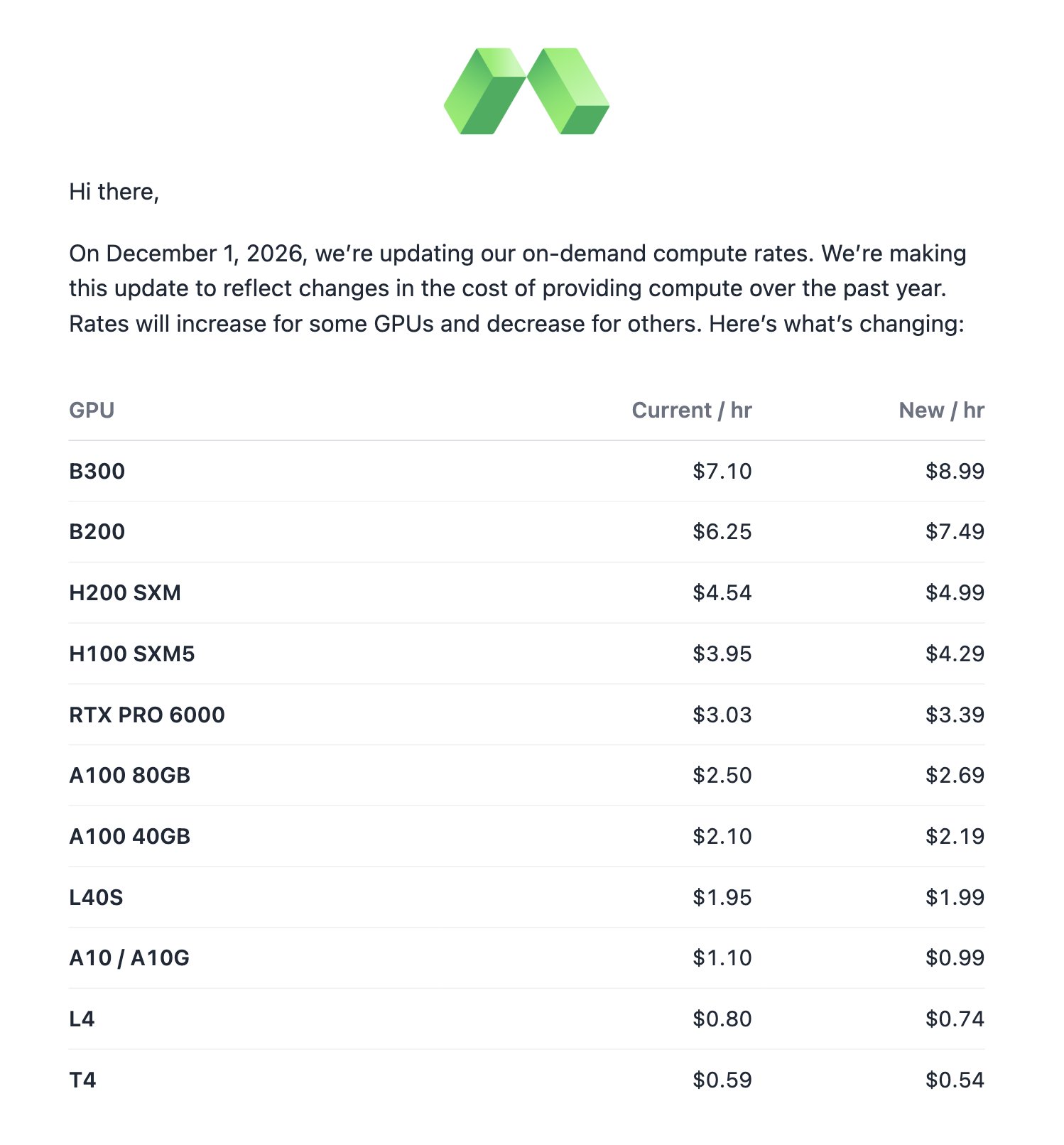
The newest compute gets dearer before it gets cheaper. From 1 December, one GPU cloud is raising its hourly rate for Nvidia’s newest chips: the B200 goes from $6.25 to $7.49, the B300 from $7.10 to $8.99, while older chips get cheaper. One engineer’s advice was to get hold of compute now, before things get ugly. Anthropic’s own filing warns that demand has pushed up the cost of compute.
Compute starts to be priced like labour. At $7.49, an hour on a B200 will cost more than the US federal minimum wage of $7.25. Jun Song, who runs a data-centre hardware business in Korea, takes the maths further. By Song’s numbers, a $14,000 graphics card renting at $3.39 an hour now earns more in a year than the average person does.

you should scramble to get compute because I have a feeling it's about to get ugly

Did some quick math today.
1. A $14,000 RTX 6000 Pro rents for $3.39/hr.
2. That is $29,696.40 per year.
3. The average adult globally makes $23,000 a year (adjusted for purchasing power).We just crossed a crazy line where one graphics card has higher economic value than a human being.
The maths is loose: a GPU works all 8,760 hours of the year, and a person doesn’t. But the direction matters more than the arithmetic. Once compute can do the work, a seller can price it against the work instead of the chip.
Public markets ask every plan to pay its way. Once Anthropic lists, its pricing answers to quarterly results. If OpenAI follows in 2027, the two labs behind Claude and ChatGPT will both be reporting every quarter.
More doors close at short notice. OpenAI plans to end Cursor’s direct access to its models on 12 November, saying it couldn’t be confident that Cursor’s new owner, SpaceX, would stay within its terms. Cursor’s chief executive said the company had trusted OpenAI as neutral infrastructure.
It has happened before. In June 2025, Windsurf lost nearly all its direct Claude capacity with less than five days’ notice, while offering to pay for all of it. In June 2026, US export controls forced Anthropic to suspend its newest model for every customer for nearly three weeks. And models retire on the vendor’s calendar, sometimes about two months after they’re deprecated.
To be fair to the other side, the price of a given level of intelligence keeps falling, by around ten times a year on a16z’s estimate. Sam Altman and Dario Amodei have both said that serving models already makes money, and Benedict Evans puts inference margins at 40 to 50%. Ed Zitron, who argues AI’s economics don’t make sense at all, says it’s nothing like Uber.
I think the optimists are right about unit prices. But the unit price was never the real risk.
The price can go one of two ways. Competition pushes it down towards what compute costs to produce. Dependence lets the seller price it against the value of the work instead. Which of the two you pay depends on one thing: whether you can leave.
Put plainly, whoever you can’t leave sets your price.
Remaining sovereign
Leaving is no longer theoretical.
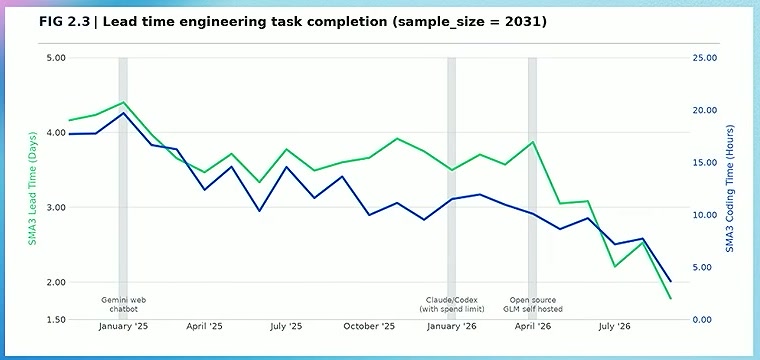
Revolut made a self-hosted open-weight model the default for about 2,000 engineers this year and kept frontier tools for the exceptions. Its bill went flat, and by its own measures coding time improved by about 60% and lead time by about 70%.

Revolut: Europe's most valuable startup ($200B) just showed the world its AI strategy.
Every company will end up copying it. […]
Uber, fittingly, now sits on the other side of the meter. Its chief technology officer says the number of people using frontier AI there has more than quadrupled since January while its cost per token fell, partly because it keeps testing new models, open-weight ones included, and uses the best one for each job. Ramp cut its own AI bill by 30% with a router that picks the model for each task.
None of these companies stopped using frontier models. They stopped depending on them. And the alternatives are close: this year the best open-weight models have trailed the closed frontier by about four months on Epoch AI’s capability index.
That’s the lesson. Adopt fast, because organisations that hand real work to AI will outrun the ones that don’t. But build so you can leave. The lock-in builds up around the model: in the prompts, tools, memory and context your teams accumulate inside one vendor’s product, which together become your organisation’s working model of itself. Models are interchangeable. That isn’t.
Our chief executive, Max Buchan, defines sovereignty as optionality and control. My colleague Ryan Radloff argues in The Arc of AI Sovereignty that the future is hybrid: some work belongs with the most capable model available, and some with a model running inside your own environment. The question is which intelligence should run where, and under whose authority.
That’s what we’re building at Valarian. Our platform, ACRA, gives you one control layer around your AI, wherever it runs: open-weight models in your own enclaves on compute you choose, frontier models through their APIs where they earn their place, and your harness, context and policies under your control throughout. When a better or cheaper model arrives, you swap it in without rebuilding the controls around it.
The labs will keep building remarkable models, and you should use them. Use them when they’re the best option for the job, and keep the ability to say no when they aren’t.
